


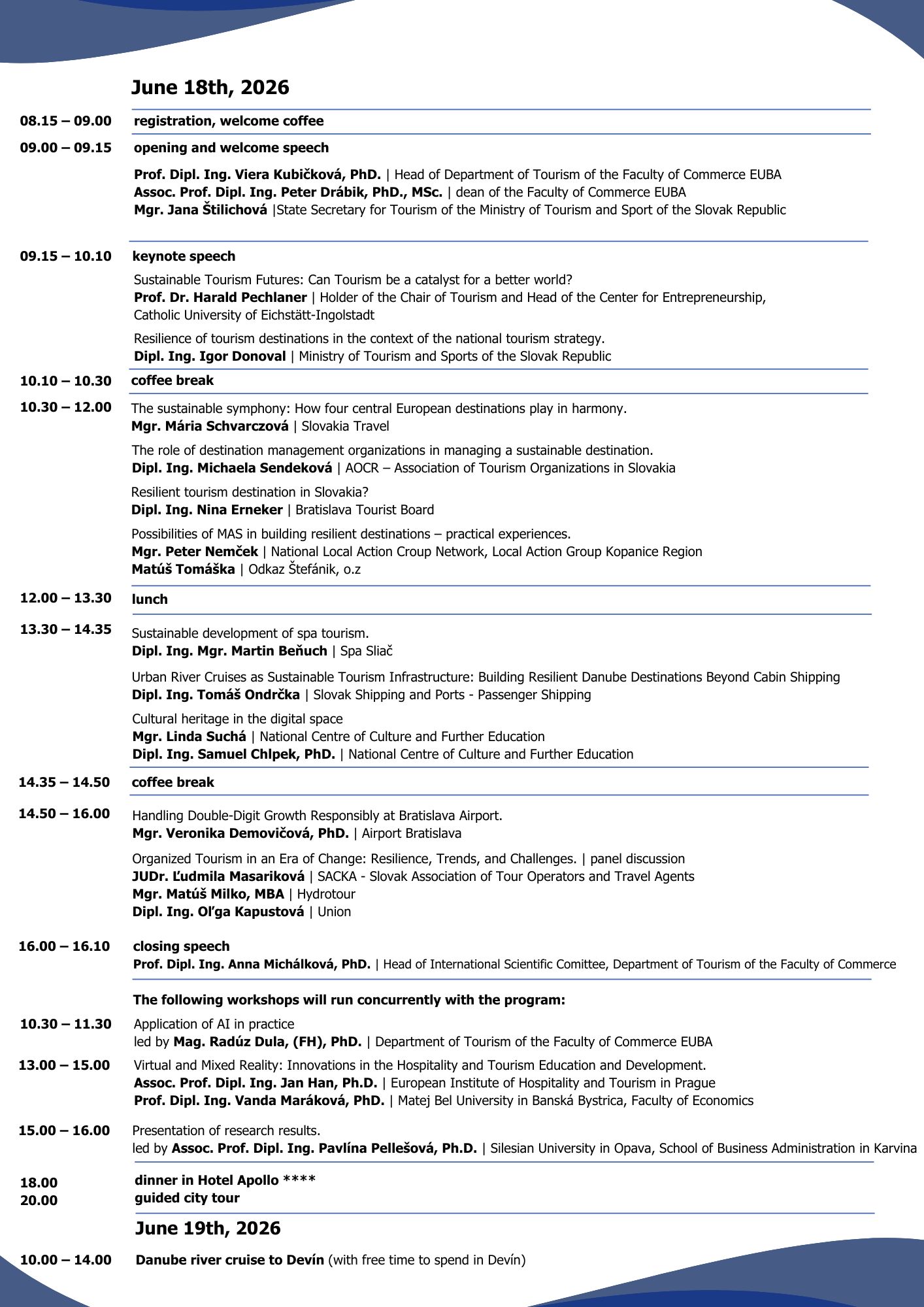
The organizer reserves the right to change the program.
The participation fee 130 € includes:
- participation in the program and conference materials,
- lunch and dinner,
- coffee break during the conference,
- evening guided city tour and cruise on the Danube to Devín with free program in Devín.
Transport and accommodation are not included in the participation fee.
You can register HERE.
Registration is open until April 30, 2026 May 8, 2026 (prolonged) and the participation fee must be paid by May 15, 2026.
SEPA payments | |
Account name: | Ekonomická univerzita v Bratislave |
Bank: | Štátna pokladnica, Radlinského 32, 810 05 Bratislava |
IBAN: | SK34 8180 0000 0070 0007 4503 |
SWIFT (BIC): | SPSRSKBA |
Variable code | 10202026 |
Payment purpose: | CONFEUBA 2026 Last name of participant |
International non-SEPA payments | |
Beneficiary bank: | Štátna pokladnica, Radlinského 32, 810 05 Bratislava SWIFT: SPSRSKBA |
Intermediary bank: | Všeobecná úverová banka, a. s., Mlynské Nivy 1, 829 90 Bratislava |
IBAN | SK34 8180 0000 0070 0007 4503 |
SWIFT | SUBASKBX |
Variable code: | 10202026 |
Payment purpose: | CONFEUBA 2026 Last name of participant |
INTERNATIONAL SCIENTIFIC COMMITTEE
prof. Ing. Anna Michálková, PhD. | Bratislava University of Economics and Business, Faculty of Commerce, Head of Committee |
prof. Ing. Viera Kubičková, PhD. | Bratislava University of Economics and Business, Faculty of Commerce |
doc. Ing. Pavlína Pellešová, Ph.D. | Silesian University in Opava, School of Business Administration in Karvina |
prof. PhDr. Irena Korbelářová, Dr., | Silesian University in Opava, Faculty of Philosophy and Science in Opava |
prof. Ing. Vanda Maráková, PhD. | Matej Bel University, Faculty of Economics |
doc. Ing. Jan Han, Ph.D. | European Institute of Hospitality and Tourism, Praha |
dr hab. Izabela Michalska-Dudek, prof. UEW | Wroclaw University of Economics and Business, Faculty of Business and Management |
prof. dr hab. Aleksander Panasiuk, prof. zw. UJ | Jagiellonian University in Krakow Faculty of Management and Social Communication Institute of Entrepreneurship |
doc. Ing. Monika Naďová Krošláková, PhD. | Bratislava University of Economics and Business, Faculty of Commerce |
doc. Ing. Paulína Krnáčová, PhD. | Bratislava University of Economics and Business, Faculty of Commerce |
ORGANIZING COMMITTEE
Ing. Alexander Frasch, PhD. | Bratislava University of Economics and Business, Faculty of Commerce, Head of Committee |
Ing. Miroslava Čukanová, PhD. | Bratislava University of Economics and Business, Faculty of Commerce |
Ing. Jozef Gáll, PhD. | Bratislava University of Economics and Business, Faculty of Commerce |
Mag. (FH) Radúz Dula, PhD. | Bratislava University of Economics and Business, Faculty of Commerce |
Ing. Lenka Pekarovičová | Bratislava University of Economics and Business, Faculty of Commerce |
Ing. Lucia Uderianová | Bratislava University of Economics and Business, Faculty of Commerce |
Ing. Martin Schmidt | Bratislava University of Economics and Business, Faculty of Commerce |
Ing. Diana Gombitová | Bratislava University of Economics and Business, Faculty of Commerce |
Ing. Adriana Ferancová | Bratislava University of Economics and Business, Faculty of Commerce |
Ing. Andrej Labancz | Bratislava University of Economics and Business, Faculty of Commerce |
Ing. Filip Žiak, MBA | Bratislava University of Economics and Business, Faculty of Commerce |
Podkategórie
Partneri fakulty